

MMany people are still unaware of isomalt’s use as a sugar substitute in baking, for more than just lollipops, candy, or other sweet treats. There’s currently a high demand for low-calorie and sugar-free products. We’re taking better care of ourselves and thinking more about our health, but who can resist the occasional sweet treat? You’re probably thinking about the number of calories you consume when you bake a cake.
I’ll tell you how you can replace sugar so you can eat sweets with less guilt.
The use of isomalt as a sugar substitute
We already know from previous posts that isomalt is not sugar. So, what is isomalt? It’s a naturally occurring ingredient from the polyol group, which we can’t classify as a sugar. One of isomalt ‘s characteristics is that it has the same structure and texture as common sugar (or sucrose), making it an ideal candidate for use as a sugar substitute in baked goods. Isomalt is a bulk sweetener. These sweeteners are called bulk sweeteners because they add weight or volume to recipes. Since it has the same structure as common sugar, the conversion in a typical recipe would be 1:1, meaning we can substitute the amount of sugar in any baked goods with the same amount of isomalt. It has some unique properties that differentiate a baked good made with isomalt from one made with sugar. Let’s explore what they are.
Differences between isomalt and sugar
First: it has half the calories of sugar
This is good news. If you try a treat made with isomalt, your calorie intake is reduced by half compared to the same treat made with sugar.
Second: isomalt is suitable for diabetics
This is an important difference. Isomaltose is suitable for diabetics. As a polyol, it allows you to create a sugar-free product that can be consumed by people with diabetes .
Third difference: it doesn’t add color to your desserts
Unlike sugar, which gives a typical brown color, this can be beneficial when we don’t want that hue in our sweets.
Fourth: greater preservative power
What does this mean? Simply put, your baked goods will last longer if you use isomalt instead of sugar, because isomalt has a longer shelf life than sugar. We explained how to preserve isomalt in a previous post; you can check it out if you’re interested in learning how to do it professionally.
Fifth: cavities
Isomalt sugar does not cause cavities. Sugar does. If you want to know more, you can read the post Isomalt versus Tooth Decay
Sixth difference: sweetness
I’ll explain this point in more detail because it’s important to understand it to learn how to use this ingredient correctly in baking. Isomalt is less sweet than sugar. It provides a mild sweetness. It’s important to note that both are natural ingredients. Neither is an artificial sweetener. In most cases, the sweetness it provides is more than enough; in fact, I never add more sweetness to my recipes because I always reduce the amount of sugar.
What can I do if I consider the sweetness level of the isomalt insufficient?
We have two options:
Supplement with a small amount of another sweetener
If you want to adjust the sweetness and enhance it a bit more, simply add a small amount of another sweetener like stevia to your recipe. However, be very careful when using this second ingredient; use only a very small amount, or you risk making your dessert too sweet.
Take advantage of the fruit’s natural sweetness if the recipe allows it.
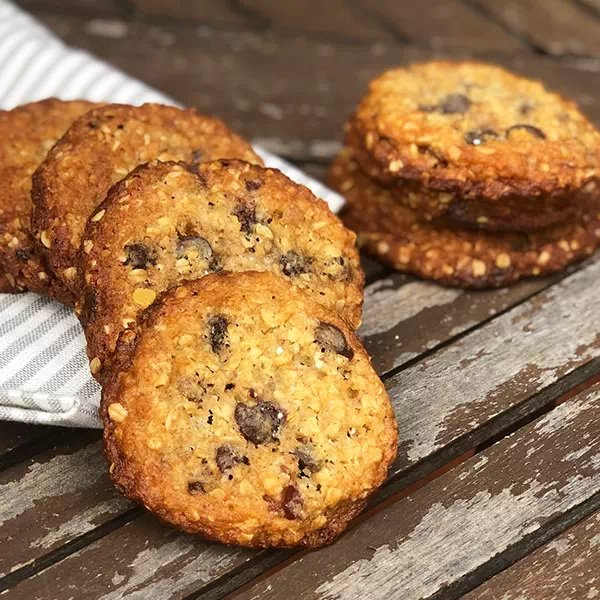
My personal recommendation is that when you use dates, raisins, or similar dried fruit in a recipe, don’t add any sweetener other than isomalt. And since a practical example is worth more than so much theory, I’m sharing a recipe so you can see the results of using isomalt as a sugar substitute. It’s for some cookies I made very recently, and they are absolutely delicious.
Recipe for oatmeal and chocolate cookies without added sugar
This recipe makes about 25 cookies.
Ingredients
- 130g of oat flakes.
- 150g of flour.
- 1 teaspoon of yeast.
- 170g of butter.
- 180g of isomalt.
- 1 teaspoon of vanilla essence.
- 1 egg.
- 150g of chopped chocolate (I use the 70% cocoa and 0% added sugars one from Mercadona)
- 30g of grated coconut (optional).
- 10 dates (You can substitute raisins, prunes or cranberries).
- A pinch of salt.
How to do it
Step 1
Sift the flour with the yeast, add the oat flakes, a pinch of salt, the chopped chocolate, the grated coconut and the chopped dates.
Step 2
In another bowl, cream the softened butter until smooth. Add the isomalt and beat until well combined. Add the egg and continue beating. Add the vanilla extract and beat for at least 10 minutes to allow the isomalt to dissolve slightly.
Important: the isomalt granules will not dissolve completely, but don’t worry, they will finish melting in the oven.
Step 3
Pour the mixture into the bowl of dry ingredients and mix well until everything is fully incorporated. Cover with plastic wrap, pressing it directly onto the surface of the dough, and refrigerate for at least 30 minutes; if it’s hot, leave it for an hour.
Step 4
Preheat the oven to 200°C (390°F). While the oven is preheating, form walnut-sized balls of dough. Place them on a baking sheet lined with parchment paper. Leave space between them so they don’t stick together while baking. You may need to use two baking sheets or bake them in two batches.
We flatten the balls slightly and put them in the oven. We lower the temperature to 180º and bake for about 12 minutes. When we take them out of the oven they will be very soft; it’s best not to touch them so they don’t lose their shape. They need to be left to cool so they firm up.
And that’s it, enjoy your oatmeal chocolate chip cookies!
Mayte Rodríguez





Leave A Comment